
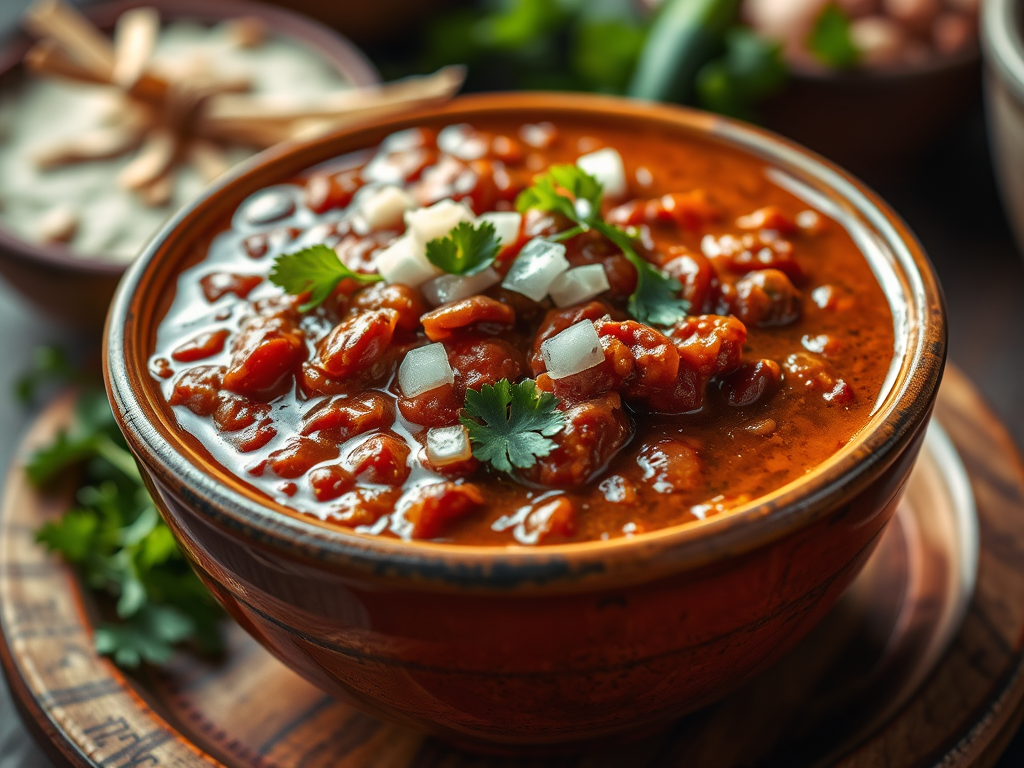
The history of chili is a fascinating blend of cultural influences. It has evolved regionally, particularly centered in the American Southwest and Texas. The dish’s origins are somewhat contested, but we can trace several key developments:
Early Origins: The basic concept of seasoned meat stewed with chili peppers likely began with indigenous peoples. These peoples were from Mexico and the American Southwest. The Aztecs and other Mesoamerican cultures had been cooking with chili peppers for thousands of years before European contact.
San Antonio’s Chili Queens: A significant chapter in chili history took root in San Antonio, Texas in the 1880s. The “Chili Queens” were Hispanic women who served chili from open-air stands in the city’s plazas. They played a crucial role in popularizing chili and making it a staple of Tex-Mex cuisine. Their stands became so famous that they attracted tourists and helped establish San Antonio as a culinary destination.
Prison Chili: In Texas prisons during the late 1800s, chili became a standard meal. It was inexpensive and could feed many people. This led to the development of what became known as “prison chili” – a style that influenced many later recipes.
The Rise of Chili Parlors: In the late 1800s and early 1900s, chili parlors began appearing across the United States. They emerged particularly in Texas and the Midwest. These establishments helped spread chili’s popularity nationwide. One of the most famous was in Springfield, Illinois, where it evolved into their distinctive style with finely-ground meat.
Cincinnati Chili: In the 1920s, Macedonian and Greek immigrants created their own unique version of chili. They served it over spaghetti with distinct spices like cinnamon and allspice. This became known as Cincinnati chili and represents one of the most distinctive regional variations.
Competition and Innovation: The first chili competition was held at the 1952 Texas State Fair. It helped standardize certain styles. It also encouraged innovation. The Terlingua Championship Chili Cook-Off started in 1967. It became one of the most prestigious chili competitions. It helped form modern competition rules.
Commercialization: The 1890s saw the first commercialization of chili when Willie Gebhardt began selling chili powder in San Antonio. By the 1950s, companies like Wolf Brand Chili were canning and mass-producing chili, making it available nationwide.
Regional Variations: Different regions developed their own distinct styles:
- Texas Red: The classic style with no beans, just meat and chili
- New Mexico Style: Often made with pork and New Mexico chiles
- Verde: Made with tomatillos and green chiles
- Springfield Style: Using finely-ground meat
- Vegetarian: Emerging in the 1960s and 70s with the vegetarian movement
The “No Beans” Debate: One of the most contentious issues in chili history is whether beans belong in the dish. Traditional Texas chili contains no beans. This absence leads to the famous saying “If you know beans about chili, you know chili ain’t got no beans.” However, many regional variations embrace beans as a key ingredient.
Today, chili continues to evolve with new interpretations incorporating different meats, vegetables, and international influences. It remains a quintessential American dish that reflects the country’s diverse culinary heritage and capacity for regional adaptation.
While chili as we know it today is more closely linked with Tex-Mex cuisine, its Mexican roots run deep. Let’s explore the Mexican connections:
Pre-Hispanic Origins: The fundamental elements of chili trace back to indigenous Mexican cooking traditions. The Aztecs, Maya, and other Mesoamerican peoples had been cooking with chili peppers for thousands of years. They often combined dried meat with chili peppers. They added local spices to create dishes that could be easily preserved and transported.
Traditional Mexican Dishes: Several traditional Mexican dishes influenced what would become chili con carne:
- Chile con carne originated in northern Mexico. It is especially popular in states like Chihuahua. Ranchers there would dry beef and combine it with chiles and spices.
- Pobre del chile was a stew made by indigenous peoples using whatever meat was available, combined with local chiles.
Los Chilis: In 16th and 17th century Mexico, a dish called “los chilis” consisted of meat, chiles, and native spices. Spanish colonizers documented these preparations in their accounts of the New World.
The Role of Mexican Women: In the 1800s, Mexican women were crucial in developing what we now know as chili. These women, known as “chili queens” in San Antonio, played a key role in popularizing the dish. Many of these women came from Mexico or had Mexican heritage. They brought their traditional cooking methods and adapted them to local tastes and ingredients.
Key Mexican Ingredients: Many essential chili ingredients have Mexican origins:
- Various types of chile peppers (ancho, pasilla, guajillo)
- Cumin (brought to Mexico by Spanish colonizers but deeply integrated into Mexican cuisine)
- Mexican oregano
- Traditional preparation methods like toasting and grinding spices
Modern Mexican Perspective: Interestingly, what Americans call “chili” is not commonly found in Mexico today. Modern Mexican cuisine has its own array of chile-based stews and sauces, such as:
- Carne con chile colorado
- Various regional moles
- Caldos and guisados (stews) featuring chiles
The Border Influence: Chili’s development as we know it today occurred in the borderlands between Mexico and Texas. Here, Mexican cooking traditions merged with American ingredients and tastes. This cultural mixing zone created not just chili, but the entire category of Tex-Mex cuisine.
fascinating regional variations of chili across North America.
Here are some of the most distinctive:
Texas Red
- The most famous style, originating in Texas
- Made with beef and dried red chiles
- Strictly no beans or tomatoes
- Often uses coarse-ground or cubed beef rather than ground meat
- Heavy emphasis on chile peppers and cumin
- Known for its deep red color and rich, spicy flavor
Cincinnati Chili
- Created by Greek immigrants in the 1920s
- Uniquely spiced with cinnamon, allspice, and sometimes chocolate
- Served over spaghetti with specific “ways” of ordering:
- Two-way: Spaghetti and chili
- Three-way: Adds shredded cheese
- Four-way: Adds diced onions
- Five-way: Adds kidney beans
New Mexico Style
- Uses New Mexico chiles (either red or green)
- Often made with pork instead of beef
- Frequently includes local ingredients like piñon nuts
- Generally thinner than Texas style
- May include beans, but this varies by region
Springfield (Illinois) Style
- Very finely ground beef
- Thinner, more sauce-like consistency
- Often served on hot dogs or in a “slinger” (with eggs and hash browns)
- Usually includes beans
Kansas City Style
- Thicker, more tomato-based
- Usually includes beans
- Often served with a side of crackers
- More likely to include additional vegetables
Detroit Coney Chili
- Specifically designed for hot dogs
- Very finely ground beef
- No beans
- Often includes heart and other organ meats
- More sauce-like consistency
Oklahoma Style
- Similar to Texas style but usually includes beans
- Often incorporates native ingredients like corn
- Tendency to be spicier than other regional variants
- Sometimes includes fresh vegetables
Colorado Green Chili (Chile Verde)
- Made with Pueblo or Hatch green chiles
- Usually made with pork
- More of a gravy-like consistency
- Often served as a sauce over burritos
- Contains tomatillos and sometimes tomatoes
St. Louis Style
- Similar to Cincinnati style but with different spices
- Often served over spaghetti
- Usually includes beans
- Tends to be sweeter than other varieties
Southwest Border Style
- Heavy Mexican influence
- Often includes masa harina as a thickener
- More likely to use multiple types of chiles
- May include Mexican chocolate
- Often garnished with fresh cilantro and lime
These variations reflect local ingredients, immigrant influences, and regional tastes. Each style has its devoted followers who often insist their version is the “true” chili.
Here’s a straightforward, classic chili recipe that’s easy to make:
Basic Chili Recipe (serves 4-6)
Ingredients:
- 1 pound ground beef
- 1 onion, diced
- 3 cloves garlic, minced
- 1 (15 oz) can kidney beans, drained
- 1 (14.5 oz) can diced tomatoes
- 1 (8 oz) can tomato sauce
- 2 tablespoons chili powder
- 1 teaspoon ground cumin
- 1 teaspoon paprika
- 1/2 teaspoon salt
- 1/2 teaspoon black pepper
- Optional toppings: shredded cheese, sour cream, diced onions
Instructions:
- In a large pot over medium heat, brown the ground beef and break it into small pieces (about 7-8 minutes)
- Add diced onion to the beef and cook until softened (about 5 minutes)
- Add minced garlic and cook for 1 minute
- Stir in all the spices (chili powder, cumin, paprika, salt, pepper)
- Add diced tomatoes, tomato sauce, and kidney beans
- Bring to a simmer, then reduce heat to low
- Cover and let simmer for at least 30 minutes (longer for better flavor)
- Taste and adjust seasonings as needed
- Serve hot with your choice of toppings
Tips:
- For thicker chili, simmer uncovered
- For spicier chili, add cayenne pepper or diced jalapeños
- Leftovers taste even better the next day
- Can be made in a slow cooker (6-8 hours on low)
How Hot can you take it?
The heat levels in chili can be measured in several different ways. One method looks at the peppers used. Another considers the resulting dish. Here’s a breakdown:
Chili Pepper Heat Scale (Scoville Heat Units/SHU):
Mild Peppers (100-2,500 SHU):
- Poblano: 1,000-1,500
- Anaheim: 500-2,500
- Jalapeño: 2,500-8,000
Medium Heat (2,500-30,000 SHU):
- Serrano: 10,000-25,000
- Hungarian Wax: 5,000-10,000
- Chipotle (smoked jalapeño): 5,000-10,000
Hot Peppers (30,000-100,000 SHU):
- Habanero: 100,000-350,000
- Scotch Bonnet: 100,000-350,000
- Thai Chili: 50,000-100,000
Super Hot (Over 300,000 SHU):
- Ghost Pepper: ~1,000,000
- Carolina Reaper: ~1,600,000+
- Trinidad Scorpion: ~1,200,000
Common Chili Dish Heat Levels:
Mild:
- Uses mostly poblanos or mild chili powder
- Suitable for most people
- Focus on flavor over heat
- Often has more tomato base
Medium:
- Usually contains jalapeños
- Noticeable heat but not overwhelming
- Good balance of heat and flavor
- Most competition chilis are medium heat
Hot:
- Contains habaneros or multiple hot peppers
- Significant heat that builds
- May cause sweating
- Heat is prominent but shouldn’t overpower flavor
Extra Hot:
- Uses ghost peppers or other super-hot varieties
- Extreme heat that lingers
- Usually requires careful handling during preparation
- Often made specifically for heat challenges
Tips for Controlling Heat:
- Remove pepper seeds and membranes for less heat
- Add dairy (sour cream, cheese) to reduce heat
- Balance with acidic ingredients (tomatoes, lime)
- Start with less pepper and add more as needed
- Remember heat intensifies as chili cooks
 D'Lightful Dishes LLC, Personal / Private Chef Services